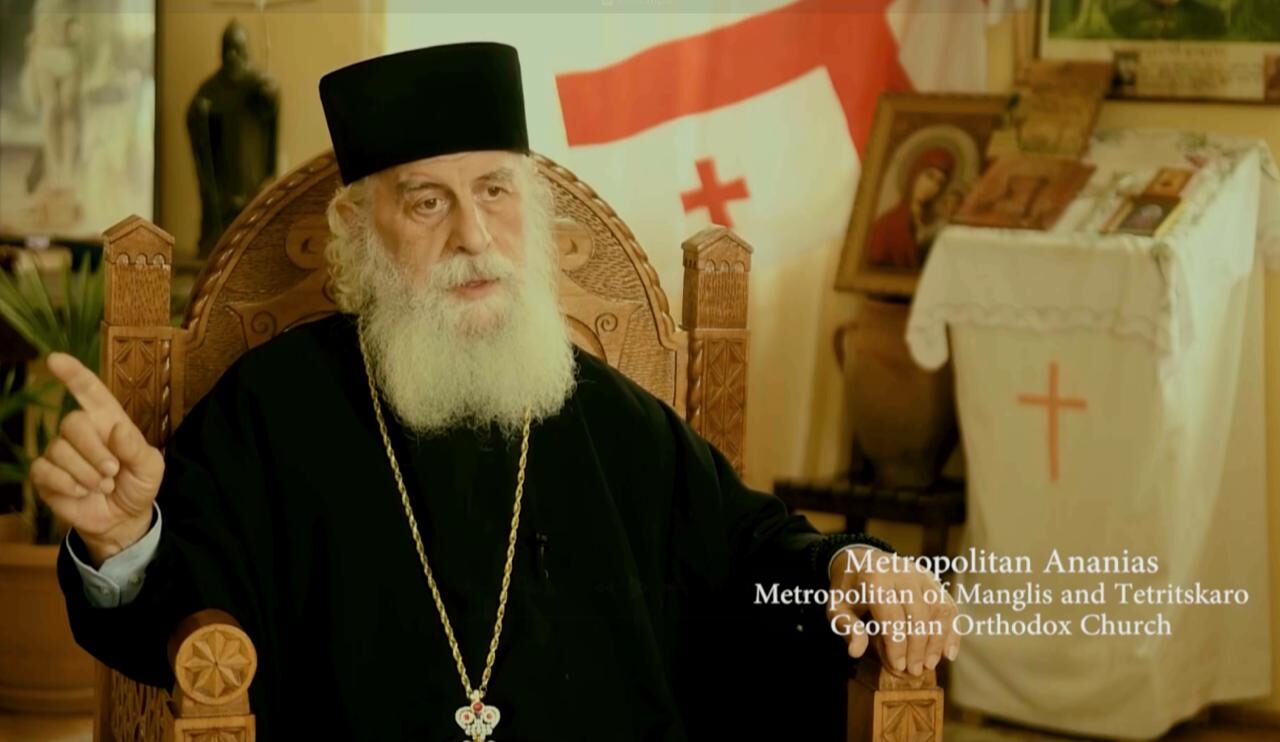
The history of the ancient Caucasian Albanian Church remains one of the complex and insufficiently known pages of the Christian past of the South Caucasus. It once held an important place in the religious life of the region, possessing its own church tradition, spiritual centers, and written heritage. However, as a result of political upheavals, interchurch disagreements, and changes in power, its independence was gradually lost, and a significant part of its historical heritage became associated with other church traditions. Metropolitan Anania of Manglisi and Tetritskaro, a member of the Holy Synod of the Georgian Orthodox Church, Doctor of Historical Sciences, and researcher of Caucasian church history, spoke about how the fate of the Albanian Church unfolded, what role Byzantium, Persia, the Arab Caliphate, and the Armenian Church played in these processes, and why the history of Caucasian Albania continues to arouse interest today.
According to the Metropolitan, in the first centuries of the spread of Christianity in the South Caucasus, there were three ancient church traditions, namely Georgian, Armenian, and Albanian. Their development occurred in close interaction, but subsequent historical events significantly changed the relations between them. The confrontation between the two largest powers of that time, the Byzantine and Persian Empires, each of which sought to strengthen its influence in the Caucasus, played a particularly important role.
The period of Arab domination occupies a special place in the narrative of the Metropolitan, when the position of the Albanian Church, in his assessment, underwent the most serious changes. Referring to the medieval historical monument History of the Country of Aluank, traditionally associated with the name of Movses Kaghankatvatsi, the Vladyka spoke about the events surrounding the Albanian Catholicos Nerses I Bakur, whose residence was located in Barda, modern Barda in the territory of Azerbaijan. Metropolitan Anania noted that the Armenian Catholicos appealed to the Arab authorities with accusations against the primate of the Albanian Church. Nerses was blamed for his adherence to the Byzantine church tradition and for praying for the Byzantine emperor. In the context of the confrontation between the Arab Caliphate and Byzantium, such accusations had not only religious but also political significance. After the intervention of the Arab authorities, the Albanian Catholicos was detained and taken to Dvin. The Metropolitan also spoke about the humiliation to which, according to the historical narrative, the ruler of Gardman associated with him was subjected. According to the Vladyka, Nerses died eight days after these events.
Metropolitan Anania considers this story as one of the most dramatic episodes in the fate of the ancient Albanian Church. However, in his opinion, the consequences of what happened were not limited to the fate of a single church primate. Subsequently, a church council was held in Barda, the decisions of which significantly limited the independence of the Albanian Church. The election of its Catholicos became dependent on approval from the Armenian Church. At the same time, the spread of the Armenian language in church life intensified. The Vladyka considers these very changes to be the beginning of the gradual loss of the independent position of the Albanian Church. In his account, it was not only about the transition of church administration under another jurisdiction, but also about a deeper process that affected the liturgy, writing, and historical memory of the local Christian population.
The fate of the ancient Albanian writing system causes particular concern for the Metropolitan. According to him, medieval sources contain information about the destruction of church books and manuscripts. He mentions a tradition according to which some Albanian manuscripts were thrown into the Tartar River, which he associates with the modern Terter River. Metropolitan Anania believes that such events could have severe consequences for the preservation of the independent spiritual tradition of Caucasian Albania. After all, writing and the liturgical language are not only means of religious communication, but also the most important carriers of the historical memory of a people.
At the same time, as the Metropolitan notes, not all of the Albanian book heritage was lost. Some monks managed to preserve individual manuscripts and left their native lands. Some of them went to Georgia and subsequently reached the Monastery of Saint Catherine on the Sinai Peninsula. The Metropolitan associates the preservation of certain monuments of ancient Albanian writing with this circumstance. He draws attention to manuscripts in which the original texts were later erased, and Georgian language records appeared over them. Such manuscripts are known as palimpsests and are of particular value for studying the history of Christian writing in the Caucasus. According to the explanation of the Metropolitan, the appearance of new texts over old ones could be related to the gradual disappearance of the bearers of the original written tradition. The very fact of the preservation of such monuments allows researchers to access the linguistic and spiritual heritage of ancient Caucasian Albania many centuries later.
Considering the fate of the Albanian Church, Metropolitan Anania draws a historical parallel with the Georgian Church, which also had to defend its own liturgical tradition under conditions of foreign political and religious influence. He attaches special importance to the activities of the Georgian Catholicos Kirion at the end of the sixth and beginning of the seventh centuries. At that time, the influence of the Armenian Church intensified in parts of historical Georgian lands, primarily in Gugark, and in some temples, services began to be conducted in the Armenian language. According to the Metropolitan, Kirion made efforts to restore the Georgian liturgy, which caused serious disagreements with the Armenian clergy. These events are reflected in the historical collection Book of Epistles, which contains the correspondence of church and political figures of that time.
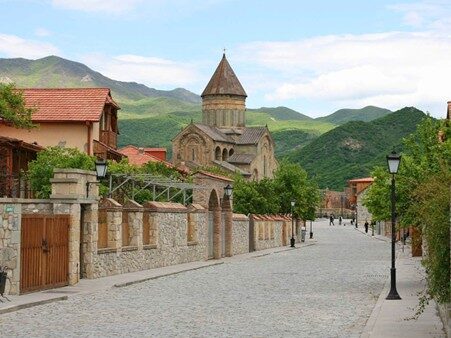
The disagreements led to a deep division between the two churches. According to the account of the Vladyka, the Armenian Catholicos Abraham issued a message that restricted religious and public contacts between Armenians and Georgians, including visits to Georgian shrines. The Jvari Monastery in Mtskheta and the temple in Manglisi, which for centuries had been one of the prominent centers of Christian pilgrimage, were specifically mentioned. The Metropolitan reminds us that, according to Georgian church tradition, Manglisi kept relics associated with the crucifixion of Jesus Christ, which were given to the Georgian kingdom during the reign of Emperor Constantine. Thanks to this, the temple attracted pilgrims not only from Georgia, but also from Armenia and Caucasian Albania.
Comparing these events with the fate of the Albanian Church, the Vladyka emphasizes the importance of preserving the liturgical language, church administration, and its own written tradition. In his understanding, it was these components that allowed ancient Christian communities to maintain historical continuity even in times of political upheaval. During the conversation, an appeal addressed to the Prime Minister of Georgia on December 12, 2014, by the head of the Armenian diocese, Bishop Vazgen Mirzakhanyan, was discussed. The interview mentioned a list of 442 churches, monasteries, and other religious objects to which, according to the information presented by the journalist, the Armenian side laid claim. Commenting on this appeal, Metropolitan Anania expressed strong disagreement with the historical grounds for such claims. In his opinion, a significant part of the mentioned temples is of Georgian origin, despite the fact that during certain periods they were under the administration of the Armenian Church. The Vladyka also criticized the decision to appeal directly to the head of government rather than to the Patriarch of Georgia. He believes that issues of church history and temple ownership should be considered primarily with the participation of church authorities and specialists who possess the necessary historical knowledge. The Metropolitan suggested that the appeal to secular authorities might have been due to a calculation of their insufficient awareness of church history issues. He called the presented claims historically unfounded and warned that such disputes could complicate relations between the two churches.
This topic is also directly related to the study of the heritage of Caucasian Albania. The history of the region shows how complex the issues of ownership of ancient Christian monuments can be, especially when state borders, church administration, liturgical languages, and population composition have changed over many centuries.
The Metropolitan paid special attention to the modern descendants of the population of ancient Caucasian Albania. He primarily mentioned the Udi people, whom he associates with the historical region of Uti and the ancient Albanian population. According to him, the Udi people have maintained a connection with this historical tradition, continuing to live in various districts of modern Azerbaijan, including the Oguz district.
The possibility of restoring historical justice regarding the ancient Albanian Church also became an important topic of the conversation. Having set forth his own understanding of the reasons for its loss of independence, Metropolitan Anania noted that the history of the Albanian Church is not limited to the distant medieval past. Its written heritage, ancient temples, church traditions, and the memory of the Christian communities of Caucasian Albania continue to be of interest to historians, theologians, and cultural heritage researchers.
The history of the Caucasian Albanian Church reminds us of how closely the fates of the peoples of the South Caucasus are intertwined. Over the centuries, states, borders, and church jurisdictions have changed here, but the spiritual and cultural monuments created by previous generations have continued to remain a part of the common history of the region. The preservation of ancient temples, the study of manuscripts, respect for historical memory, and open scientific dialogue can help to better understand the past of Caucasian Albania. After all, genuine respect for history begins not with competition for heritage, but with the desire to preserve it for future generations.